A broken garage door spring can feel urgent right away. The door may not lift, it may stop mid-travel, or it may refuse to close consistently. When that happens, many homeowners assume emergency service is the only option. In reality, urgency depends on what the door is doing right now, whether the garage is secure, and whether the system is stable enough to remain in place until a scheduled visit.
Emergency garage door spring repair is meant for situations where safety, access, or security cannot wait. This article explains when emergency service is truly necessary, when a standard appointment is usually appropriate, what a technician checks during urgent calls, and how to reduce risk while you arrange professional service.
When a Garage Door Spring Problem Becomes an Emergency
Emergency service is not just “fast service.” It is a service that addresses a situation where delaying repair creates a clear risk.
If you are dealing with a spring failure and want a clear next-step plan before scheduling service, read What Should You Do When You Have A Broken Garage Door Spring?
With spring failure, the risk typically falls into three categories:
Safety Risk
A door that is unstable, partially open, or moving unpredictably can create a hazardous situation. Springs operate under strong tension, and spring-related failures can affect cables, drums, and brackets.
Security Risk
If the door cannot close or stay closed, the garage may not be secure. This matters even more when the garage connects directly to the home.
Access Risk
If a vehicle is trapped inside, or the door is stuck open and you cannot safely close it, access becomes a practical emergency.
Emergency garage door spring repair is designed to restore safe, controlled operation and secure closing as soon as possible, without creating additional damaged parts.
When Emergency Garage Door Spring Repair Is Usually Necessary
There are specific scenarios where urgent service is the safest choice. These are the most common.
The Door Is Stuck Open And Will Not Close
If the door is open and cannot be closed, security is the primary concern. A wide-open garage can expose tools, storage, and interior access points. It can also allow weather, debris, or water intrusion into the garage.
A technician can inspect the spring system, check cables and drums, and restore controlled movement so the door can close reliably.
The Door Is Partially Open And Unstable
A door that is stuck halfway can be more concerning than one that is fully open or fully closed. It may be unsupported and could shift unexpectedly. It may also place an abnormal load on cables, which can increase the chance of additional failures.
This is a situation where emergency service often makes sense because stability matters more than speed.
The Door Will Not Open, and a Vehicle Is Trapped
If the garage is the only practical exit for your vehicle and you cannot open the door safely, urgent service may be needed. A broken spring can make the door too heavy for the opener to lift. Forcing the operation can strain the opener and can worsen cable issues.
The Door Closed, but Cannot Stay Closed Reliably
Some spring failures lead to inconsistent closing. The door may touch the floor, then reverse, or it may stop before sealing. If the door cannot close consistently, security is not dependable. Emergency service may be necessary if you cannot secure the door.
Cables Appear Loose Or Off The Drums
Loose cables are a major warning sign. Springs and cables work together. When spring tension changes suddenly, cables can lose wrap or shift. If the cables are visibly slack or miswrapped, the door can lift unevenly or bind, which increases risk.
In that case, urgent service is often appropriate because cable trouble can lead to unstable movement.
The Opener Strains, Jerks, Or Makes New Loud Sounds With The Door
A broken spring can cause the opener to overwork. If the opener is trying to lift a door without spring support, you may hear strain, jerking, or repeated stopping. That behavior can indicate the door is too heavy and out of balance.
Emergency garage door service can prevent additional damage to the opener parts and restore proper balance.
If you want to confirm whether what you are seeing points to true spring failure or another system issue, read How Do You Know If a Garage Door Spring Is Broken?
When Emergency Garage Door Spring Repair Is Often Not Necessary
Not every spring issue requires urgent scheduling. If the situation is stable and secure, a standard appointment is often fine.
The Door Is Fully Closed And Stays Closed
If the door is closed, sealed, and stable, the security risk may be low. In many cases, homeowners can schedule a standard appointment, as long as the door is not being forced to operate.
The Garage Is Secure Through Another Entry
If you can safely enter and exit through another door and the garage door can remain closed, urgency may be lower. The priority becomes restoring regular operation without forcing movement.
The Door Has Spring Wear Signs But Has Not Failed Yet
Sometimes a system shows warning signs, but the spring has not snapped. These signs can include slow lifting, inconsistent travel, or increased noise. In these cases, a scheduled inspection is typically appropriate.
If you are weighing whether repair work is enough or replacement is the safer long-term direction, read Should You Repair or Replace a Broken Garage Door Spring?
A Clear Decision Guide For Homeowners
If you are unsure, use this practical guide. It does not involve DIY steps. It simply helps you decide whether urgency is appropriate.
Emergency Service Is Often Appropriate When
- The door is stuck open or partially open
- The door cannot close consistently, and security is not dependable
- A vehicle is trapped, and you cannot safely open the door
- cables are slack or appear off the drums
- The door movement feels unstable or unpredictable
A Standard Appointment Is Often Appropriate When
- The door is fully closed and stays closed
- The garage can remain secure until service
- The issue appears to be reduced performance rather than complete failure
- You can avoid operating the door until a technician arrives
This guide is not a substitute for professional evaluation, but it helps clarify what usually drives urgency.
Why Spring Failure Sometimes Becomes Urgent Fast
Homeowners often ask why a spring problem can escalate quickly. The reason is that the spring system is tied to multiple moving parts.
Springs Control Balance
A properly balanced door feels manageable because the spring system carries most of the weight. When the spring fails, the door becomes heavy, and the entire movement profile changes.
Springs Affect Cable Behavior
Cables are designed to stay under correct tension and wrap evenly on drums. When spring tension drops, cables can slacken or wrap unevenly. That can lead to crooked travel or binding.
Springs Influence Opener Strain
The opener is designed to guide motion, not lift the full door weight. When the spring fails, the opener may strain, stop, or reverse. Continued strain can lead to damaged internal opener parts.
This is why a spring problem can shift from “inconvenient” to “urgent” depending on door position and stability.
What A Technician Typically Does During Emergency Service
Emergency garage door spring repair is still professional, methodical work. The goal is safe restoration, not rushed changes.
Step 1: Safety Assessment And Work Area Control
The technician confirms door position, checks stability, and evaluates whether the door can be moved safely during service. This includes checking for cable slack and bracket stability.
Step 2: System Inspection Beyond The Spring
A professional inspection typically includes:
- spring type identification (torsion or extension)
- cable condition and wrap
- drum alignment and secure mounting
- bearing surfaces and end plates
- track alignment and roller condition
- opener interaction and travel behavior
This matters because spring failure can cause secondary issues, and secondary issues can mimic spring failure.
Step 3: Repair Or Replacement Recommendation
If the spring is snapped, replacement is commonly recommended. If the spring is intact but the system is out of balance, repair work may focus on restoring correct tension and stable travel.
Step 4: Balance Restoration And Safety Checking
After service, the technician verifies smooth travel and consistent closing. Safety checking includes confirming that the door does not bind, that the door closes evenly, and that movement is controlled.
Torsion Vs. Extension Springs And How They Affect Urgency
Spring system design affects what homeowners notice and how urgency develops.
Torsion Spring Systems
Torsion springs are mounted above the door on a shaft. When they fail, the door often becomes extremely heavy and may not lift at all. You may also see a visible gap in the spring coil.
Urgency is often higher when the door is stuck open or when cables have lost their correct wrap.
Extension Spring Systems
Extension springs run along the sides near the tracks. When they fail or lose tension, the door may lift unevenly. Pulleys and safety cables also matter on these systems. If one side is not lifting correctly, the door can travel crooked and bind.
Urgency is often higher when the door is partially open, crooked, or unstable.
Common Misconceptions About Emergency Spring Service
Misunderstandings can lead homeowners to schedule emergency service when it is not needed, or to delay when it is truly urgent.
Misconception: “If The Spring Breaks, It Is Always An Emergency”
Not always. If the door is fully closed, secure, and stable, a standard appointment may be appropriate.
Misconception: “The Opener Can Handle It Until Service”
An opener is not designed to lift the door without spring support. Trying to operate the door can lead to damaged opener parts and unstable movement.
Misconception: “If The Door Is Moving, It Must Be Fine.”
A door may still move even when out of balance, especially for a short time. That does not mean it is safe or reliable. Uneven travel, reversing, and loud strain sounds are warning signs that deserve professional inspection.
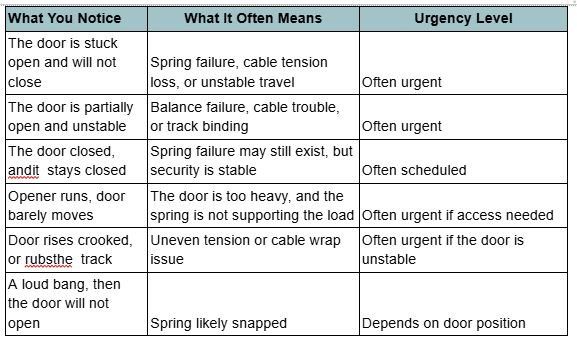
Symptom And Urgency Table
Use this table to connect what you see with typical urgency.
What To Do While Waiting For Service
Prioritize Security And Access Planning
If the door cannot close securely, that is a security issue. If a vehicle is trapped and needed urgently, that is an access issue. These two factors often determine whether emergency scheduling is the best path.
Avoid Forcing Operation
If the door is heavy, stops mid-travel, or reverses repeatedly, forcing operation can worsen wear on cables and opener parts. A technician can restore balance safely.
Prepare Clear Notes For The Technician
Helpful details include:
- whether you heard a loud bang
- whether the door is stuck open, closed, or partially open
- whether the opener runs, but the door does not lift
- whether you see slack cables or an uneven door position
These details help speed diagnosis once the technician arrives.
The Right Time to Choose Emergency Spring Service
Emergency garage door spring repair is not always necessary, but it becomes the right choice when safety, access, or security cannot wait. A door stuck open, partially open, and unstable, unable to close consistently, or showing slack cable, is often a strong reason to request urgent service. When the door is fully closed and secure, a scheduled appointment is commonly enough, as long as the door is not forced to operate.
Guardian Door & Gate can help if you are dealing with a heavy door, unstable travel, or a garage that will not secure properly, so contact us or give us a call. We focus on safe inspection, clear recommendations, and reliable repair so your garage door returns to smooth travel and consistent closing.
Frequently Asked Questions
What makes a spring issue urgent even if the door still moves?
If the door is unstable, uneven, or stops mid-travel, delaying service can increase safety risk and lead to additional damaged parts. According to Forbes Home, garage door springs and cables operate under significant tension, and spring replacement is a job best left to trained professionals, given the risk involved.
If the garage door is stuck open, is that automatically an emergency?
Usually, yes, because security is compromised and the door may not be safe to operate until the system is stabilized.
When does a partially open garage door become a safety concern?
When it looks unstable, hangs unevenly, or appears like it could shift or drop unexpectedly. A Mass General Brigham case series documents severe injuries linked to garage door spring incidents, which is why unstable spring-related symptoms should be treated as a real safety concern.
Can a spring failure cause loose cables, and why does that matter?
Yes, spring failure can reduce cable tension and affect cable wrap, which can lead to crooked travel and binding.
Why does the opener struggle when the spring is failing?
With reduced spring support, the door becomes too heavy, and the opener may strain, stop, or reverse to protect the system.
What does a technician check first during an urgent spring call?
We check door stability and cable condition first, then inspect the spring system, drums, bearings, and track alignment to confirm the failure point.
Is it safer to schedule service if the door is closed and secure?
Yes, as long as the door stays closed and you avoid operating it until service restores a safe balance.
How do torsion and extension springs affect urgency?
Torsion failures often make the door extremely heavy, while extension issues can cause uneven lift, and urgency rises when the door is unstable or cannot close securely.
What information helps us triage urgency over the phone?
Tell us the door position, whether it can close securely, whether the opener strains, and whether cables appear slack.