Legitimate quotes for a garage door service visit include far more than a single number scrawled on a receipt, no matter how small the reported issue seems. Five distinct elements distinguish a trustworthy quote from one built to hide inflated pricing or unnecessary work once the technician actually arrives.
Confirming these elements before approving anything protects against paying for a repair based on incomplete or misleading information provided over the phone. This guide breaks down each element, what it should look like, and why each piece matters before you sign anything or pay.
Key Takeaways
- Itemized costs separate parts, labor, and fees into clear individual lines.
- Specific part details replace vague terms like “hardware” or “misc parts.”
- Company information should include a verifiable name, address, and license.
- Warranty terms should cover both replacement parts and labor separately.
- Payment terms should never demand cash-only or full payment upfront.
What Elements Make a Quote Genuinely Trustworthy?
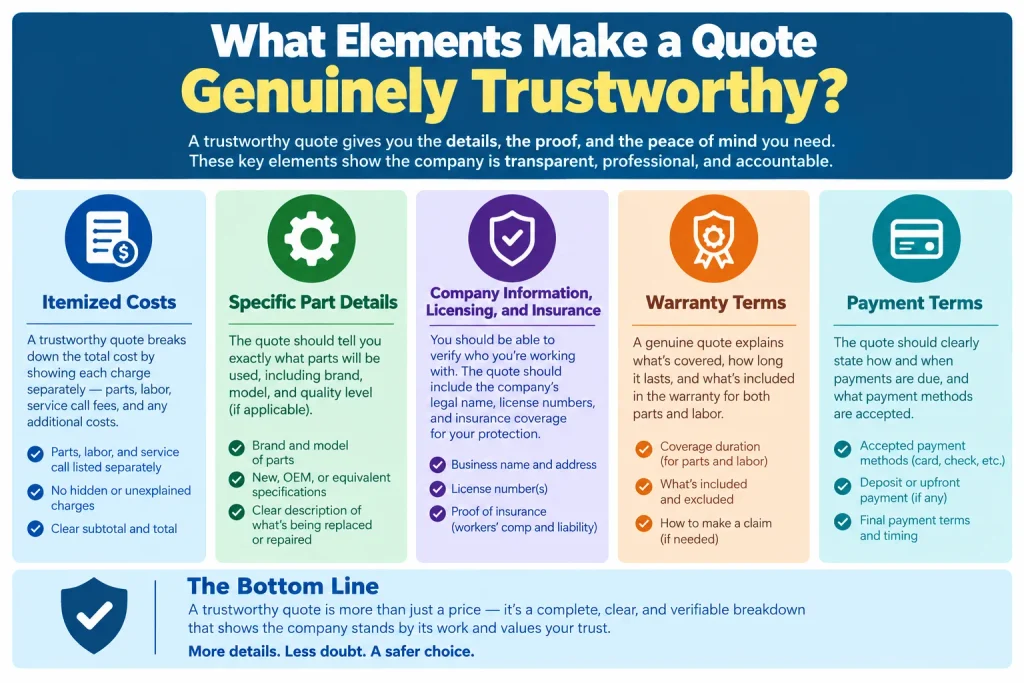
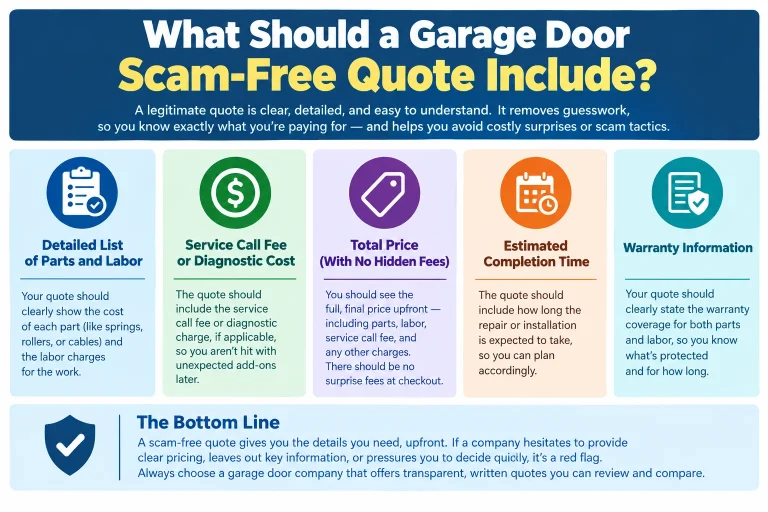
Trustworthy quotes cover five distinct elements, each protecting a different part of the transaction between homeowner and company.
| Element | What It Confirms | Why It Matters |
| Itemized Costs | Separate pricing for parts, labor, and fees | Reveals exactly what the total actually covers |
| Specific Part Details | Exact part descriptions and model numbers | Confirms what is actually being installed |
| Company Information, Licensing, and Insurance | The business is verifiable and accountable | Confirms who to contact if a dispute arises |
| Warranty Terms | Coverage terms for parts and labor | Protects against paying twice for the same failure |
| Payment Terms | Transparent expectations about method and timing | Removes pressure tied to cash-only or upfront demands |
Paperwork that holds up to this level of scrutiny protects a homeowner long after the technician leaves the driveway.
Itemized Costs
Distinct line items for parts, labor rates, and any service or diagnostic fees confirm exactly what a total actually covers.
Proper itemization usually includes each of these:
- Individual pricing listed for each part, like springs, cables, or rollers.
- Labor rates shown separately from the cost of materials used.
- Service call or diagnostic fees disclosed before any work begins.
- No bundled “misc parts” charges hiding individual costs.
- A total that adds up clearly from the listed individual items.
Itemized pricing lets homeowners verify every dollar tied to the repair long before any work begins, giving both sides something concrete to reference later.
Specific Part Details
Exact descriptions and model numbers replace vague terms like “hardware” or “misc parts” on a legitimate quote.
Real parts leave behind these specific markers:
- The brand name of each replacement component listed clearly.
- Model numbers included for major parts like a garage door opener.
- Specific descriptions instead of generic catch-all terms.
- Clear quantities for parts requiring more than one.
- Confirmation that listed parts match what actually gets installed.
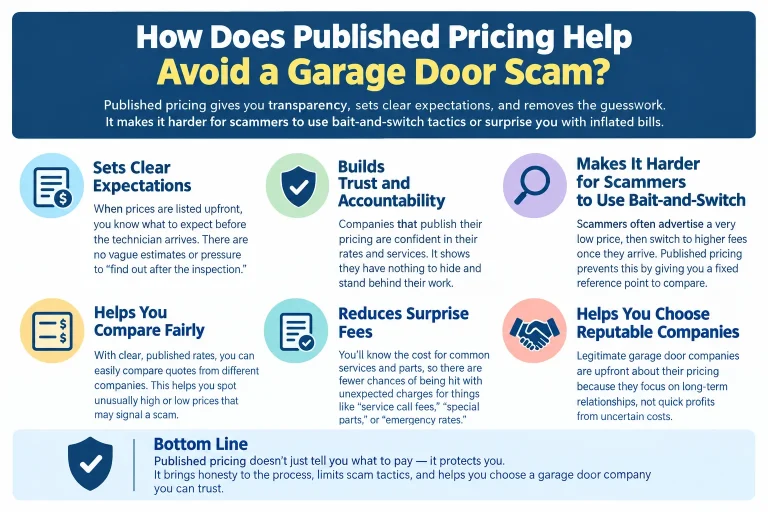
To trace exactly why documentation matters so much before approving any repair, read our guide on How Does Published Pricing Help Avoid a Garage Door Scam, which covers the full reasoning behind requiring transparency upfront.
Company Information, Licensing, and Insurance
Verifiable business details confirm a company operates transparently, with real accountability behind the quote given.
Legitimate businesses check out against these points:
- The official registered business name matching any signage or paperwork.
- A physical address, not just a listed P.O. Box.
- A working phone number tied directly to the company.
- Current contractor license and insurance numbers listed clearly.
- Contact details that match what appears on the company website.
Comparing these details against public licensing records confirms whether the company actually holds the credentials it claims.
Warranty Terms
Clear written details on parts and labor warranties confirm a company stands behind its own repair.
Genuine coverage always spells out these details:
- The exact duration of coverage for replaced parts.
- Separate warranty terms specifically covering garage door opener repair or other labor performed.
- Conditions that would void either warranty if not followed.
- Contact information for filing a warranty claim later.
- Terms provided in writing rather than a verbal promise alone.
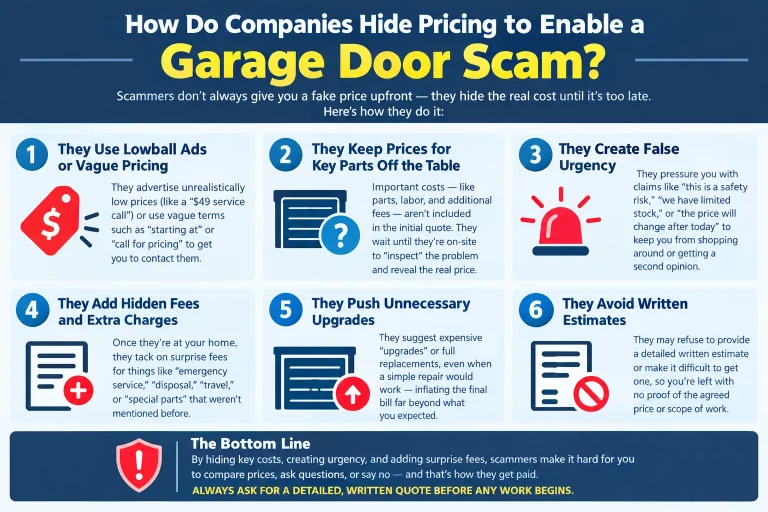
To confirm exactly which tactics companies use to avoid providing this level of written detail, read our guide on How Do Companies Hide Pricing to Enable a Garage Door Scam, which covers the specific motivations behind that avoidance.
Payment Terms
Reputable companies typically collect payment upon completion, which compares favorably with common cash-only demands that often signal a problem.
Fair terms tend to look like this:
- Payment collected only after the repair is finished.
- Multiple payment methods accepted, not cash exclusively.
- No demand for full payment before any work begins.
- A receipt or invoice provided immediately after payment.
- Terms matching what was agreed upon in the original quote.
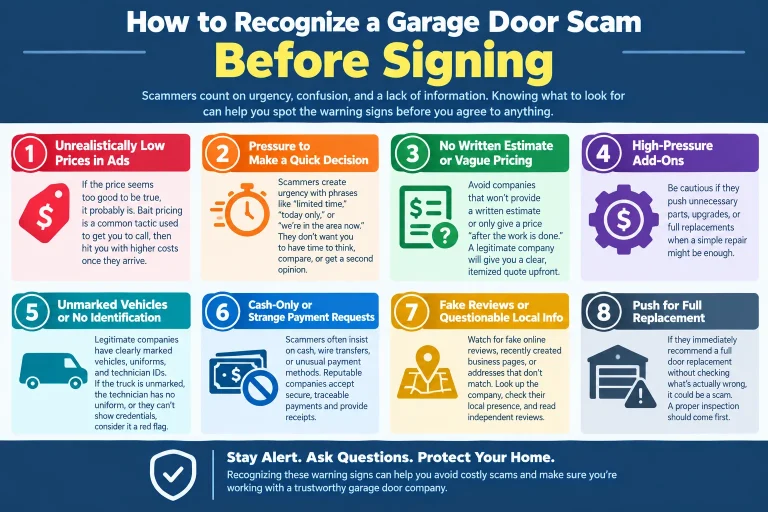
To identify exactly which payment demands signal a scam worth walking away from, read our guide on How to Recognize a Garage Door Scam Before Signing, which covers each specific warning sign worth checking.
What Should Happen If a Quote Is Missing Any of These?
Requests for garage door installation or repair work deserve the same scrutiny before approving a quote missing any of these elements.
Specific steps help when a quote leaves something out:
- Request the missing details in writing before approving anything.
- Ask directly why a specific element was left off the quote.
- Compare the incomplete quote against a second company’s documentation.
- Decline to sign until every element gets addressed clearly.
- Treat repeated omissions as a signal to consider another company.
Filling these gaps before approval protects you from surprises once the actual repair work begins, no matter how the job unfolds.
A Complete Quote Protects Every Garage Door Repair Decision
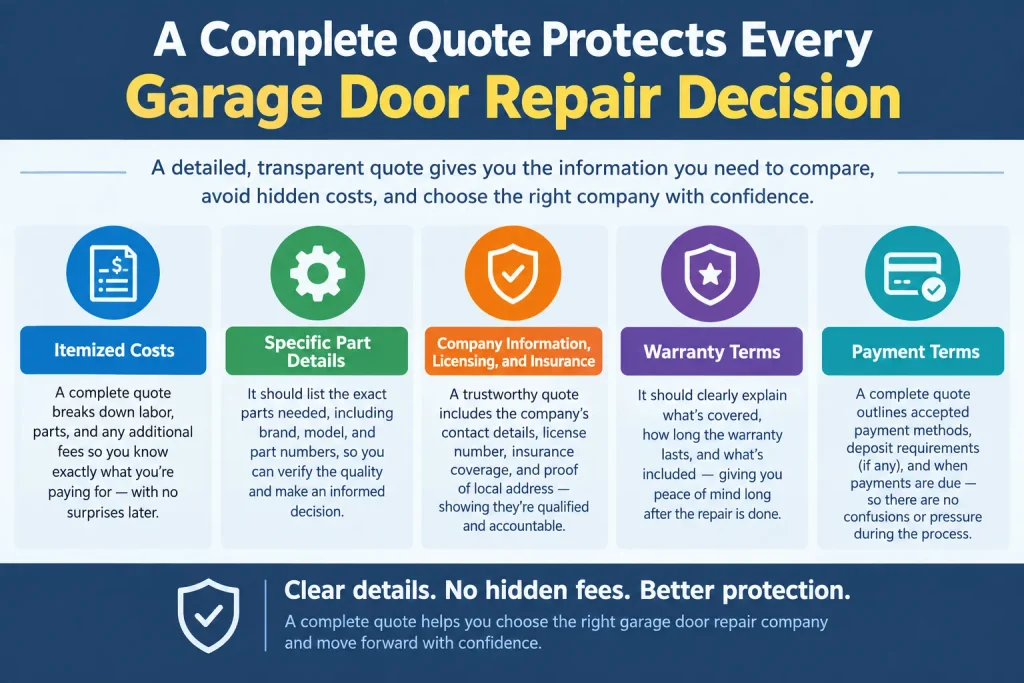
A trustworthy quote holds up to direct questions, while one built to hide costs rarely does once pressed for specifics or asked to explain a single line item. Vague or incomplete answers deserve close scrutiny before you sign anything, especially when the job is expensive or the company name is unfamiliar.
Guardian Door & Gate provides fully itemized, transparent quotes for homeowners throughout St. Louis, MO, no matter the size or type of repair involved. Contact us or give us a call today, and let our trained technicians put every detail in writing before asking for approval.
Frequently Asked Questions
Does every legitimate company list model numbers for replacement parts?
Reputable companies with genuine quality work typically provide model numbers or specific part descriptions rather than vague terms. A quote from any garage door repair company listing only generic “hardware” charges deserves a direct question before you approve it.
What if a company refuses to provide a physical business address?
Refusing to provide a verifiable, legitimate physical showroom or business address is a warning sign worth taking seriously before approving any work. A garage door company operating from a P.O. Box alone deserves added scrutiny.
Can warranty terms differ between parts and labor on the same quote?
Parts and labor commonly carry different warranty lengths, since a lifetime guarantee on lifetime springs does not always extend to the labor performed. Confirming both terms separately avoids confusion if a repair issue comes up later.
Is it reasonable to decline a company demanding full payment upfront?
Declining any company demanding full payment before work begins is entirely reasonable, especially if the pitch involves unnecessary repairs advertised at suspiciously low prices. Reputable companies typically collect payment only after the repair is complete.
Does a written quote guarantee the total will never change?
Does a written quote guarantee the total will never change?
A written estimate should stay fixed unless new issues are discovered and clearly explained during the repair, with any change reflected in updated service costs. Any change to the original total should come with a documented reason before approval.
How can a homeowner verify a listed contractor license is genuine?
Checking a public licensing database, or confirming standing with the Better Business Bureau or relevant garage door industry trade associations, usually confirms whether a listed license number matches official records. A number that fails to match deserves immediate scrutiny before approving any work.
What should a homeowner do if a quote seems unusually vague?
Requesting a detailed, itemized version of a vague quote before approval protects against unclear or inflated pricing, and checking search results for reviews of reputable garage door companies helps confirm legitimacy. A company unwilling to provide specifics deserves closer scrutiny before signing anything.
Does accepting only cash payment always indicate a scam?
Cash payment alone doesn’t always signal an unidentified technician scam, since some independent contractors prefer it for convenience. Refusing to accept any other payment method, paired with no receipt, is more telling.
Can a homeowner request a second technician’s opinion on a quote?
Requesting a second opinion on any quote is always reasonable, especially for a high-cost repair, and it often brings genuine peace of mind. A second technician’s assessment often confirms whether the original quote actually holds up.