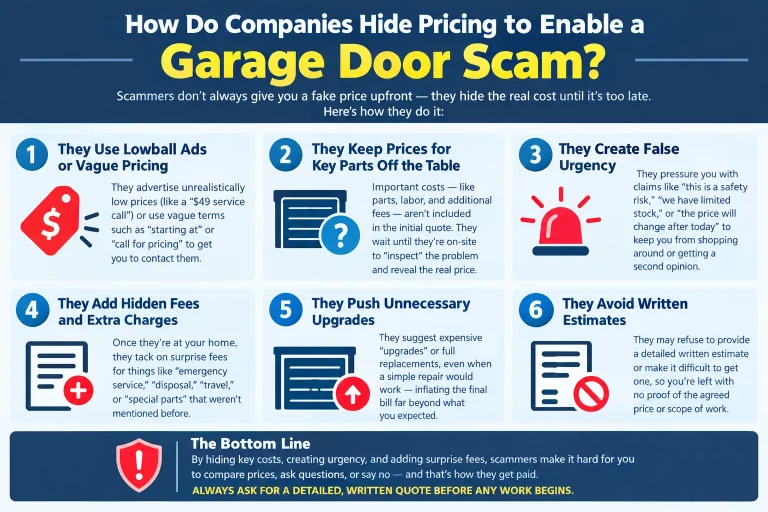
Dishonest operators rely on a specific set of tactics to keep pricing vague until a garage door service technician is already standing in the driveway with tools in hand. Seven distinct patterns explain most cases where hidden pricing sets the stage for an inflated bill once the visit actually begins.
Financial motive drives nearly every one of these tactics, regardless of how they dress them up in the moment or present them to a homeowner. This guide breaks down how each tactic works, why it succeeds so often, and how homeowners should respond once pricing stays hidden.
Key Takeaways
- Bait-and-switch service calls advertise a low fee to generate the first visit.
- Refusing phone estimates removes any benchmark before a technician arrives.
- Hostage door tactics force approval by leaving the door inoperable.
- Phantom part markups charge for components that were never actually needed.
- Discouraging comparison protects a pitch from any outside scrutiny.
What Tactics Do Companies Use to Keep Pricing Hidden?
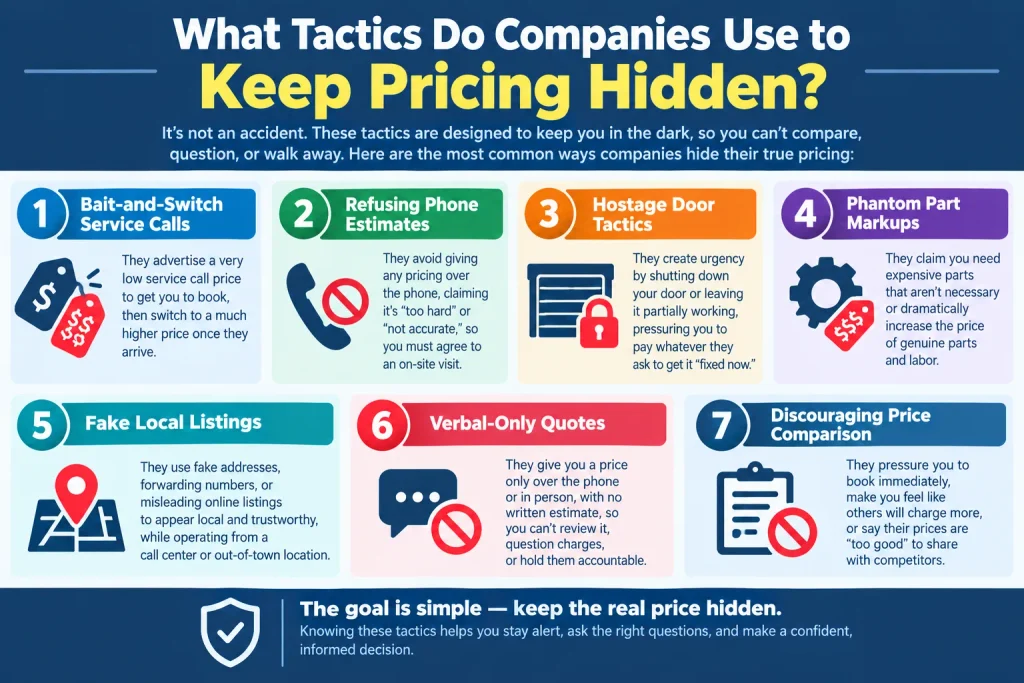
Financial incentives explain why a company would keep pricing vague instead of publishing it clearly for every potential customer to see.
| Tactic | What It Looks Like | Why It Works |
| Bait-and-Switch Service Calls | An unrealistically low advertised fee | Generates the first call before any real pricing gets discussed |
| Refusing Phone Estimates | No number given until arrival in person | Removes any benchmark a homeowner could compare against |
| Hostage Door Tactics | Disassembling the door before quoting anything | Forces approval since the door no longer functions |
| Phantom Part Markups | Charges for unnecessary or invented parts | Inflates the bill with costs that were never justified |
| Fake Local Listings | A fabricated address or business name | Hides accountability behind a false local presence |
| Verbal-Only Quotes | A number given, but never in writing | Removes documentation needed to dispute the final bill |
| Discouraging Price Comparison | Pressure against calling another company | Protects the pitch from any outside verification |
Money remains the common thread behind nearly every tactic a dishonest operator relies on, no matter how the pitch gets framed.
Bait-and-Switch Service Calls
Unrealistically low advertised fees, sometimes as little as twenty dollars, get a technician through the door before real pricing ever enters the conversation.
Watch for these signs before trusting an advertised price:
- A trip or service fee advertised well below typical market rates.
- Massive markups discovered only after the technician arrives.
- Pressure to approve inflated costs to justify the low initial visit.
- No explanation for why the final total differs so dramatically from the ad.
- A pattern repeated across multiple advertised service calls.
Spotting this pattern before scheduling protects you from a bill that bears no resemblance to the advertised fee.
Refusing Phone Estimates
Withholding pricing until a technician arrives in person removes any benchmark a homeowner could use for comparison beforehand.
A refusal to discuss cost usually looks like this:
- Insisting no ballpark figure can be given over the phone.
- Framing an in-person visit as the only way to discuss cost, especially for emergency garage door repair, where urgency makes prices easier to inflate.
- Declining even a rough price range for common repairs.
- Pressuring you to schedule immediately without discussing pricing first.
- Vague language deflecting every direct question about cost.
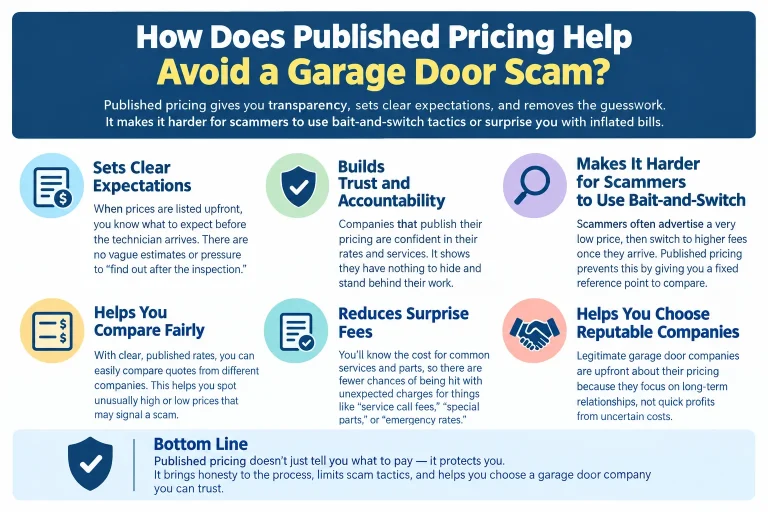
To trace exactly why published pricing protects against this exact tactic, read our guide on How Does Published Pricing Help Avoid a Garage Door Scam, which covers the full reasoning behind requiring numbers upfront.
Hostage Door Tactics
Disassembling a garage door before providing a written estimate leaves the homeowner no real choice but to approve whatever price follows.
This tactic tends to follow a predictable sequence:
- The door is rendered completely inoperable before any pricing discussion.
- Major components, such as garage door springs, are removed without prior written consent.
- Pressure to keep the door broken until payment.
- No written estimate offered before the disassembly even begins.
- A price presented only once the homeowner has no other option.
Comparing this behavior against typical consumer rights confirms how closely this tactic matches known coercive practices.
Phantom Part Markups
Charges for unnecessary, unbranded, or entirely invented parts inflate a bill well beyond what the actual repair required.
Inflated charges rarely survive these specific checks:
- No specific brand or model number listed anywhere for parts such as a garage door opener.
- A charge for a part that was never actually installed.
- Pricing for components far above typical market cost.
- No willingness to show the specific part being billed for.
- Vague line items like “misc hardware” hiding individual costs.
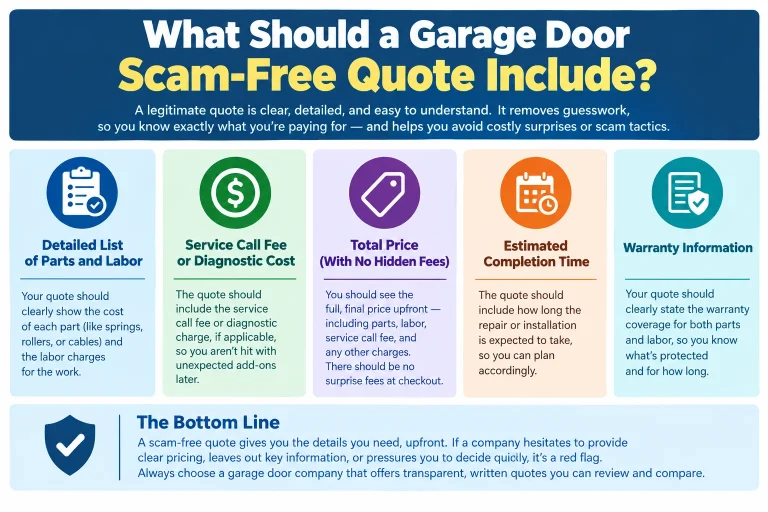
To confirm exactly which questions expose this kind of pricing concealment before approving anything, read our guide on What Should a Garage Door Scam-Free Quote Include?, which covers what a legitimate estimate should always contain.
Fake Local Listings
Fabricated local addresses, burner phone numbers, and business names mimicking established companies hide a scammer’s true identity from the start.
Check for these details to expose a fake business:
- A business name closely resembling a well-known local company.
- No verifiable physical address matching the listed information.
- A phone number disconnected or reassigned shortly after service.
- Search ads with no genuine local business behind them.
- Reviews concentrated in a suspiciously short window of time.
Comparing a company’s listed details against state business registries confirms whether the operation is genuinely local or fabricated.
Verbal-Only Quotes With No Documentation
Numbers given only by mouth, never confirmed in writing, remove the documentation a homeowner would need to dispute the final bill later.
Missing paperwork tends to show up alongside these gaps:
- No written estimate provided despite a verbal number given.
- Reluctance to send pricing details through text or email.
- A final invoice that never matches what was said out loud.
- No paper trail available if a dispute arises after payment.
- Pressure to approve based on a spoken promise alone.
Documentation this absent rarely exists for an operation planning to disappear after one job, since a real business has no reason to avoid putting anything in writing.
Discouraging Any Price Comparison
Pressure against calling a second company protects a pitch from the outside scrutiny that would otherwise expose inflated pricing.
A second opinion often triggers one of these reactions:
- Framing a competing quote as a waste of valuable time.
- Claiming a discounted price disappears once the visit ends.
- Reacting defensively when a homeowner mentions comparing quotes.
- Discouraging any request for time to think the offer over.
- Rushing paperwork before hesitation has a chance to build.
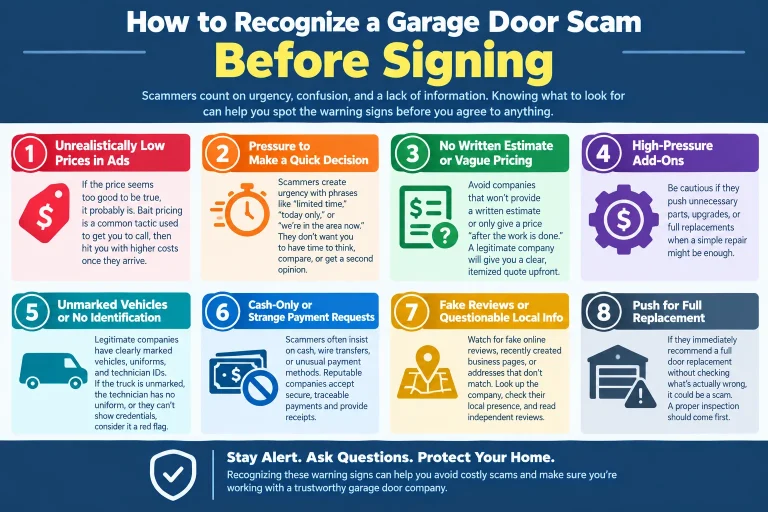
To identify exactly which questions expose this kind of pressure before any signature gets added, read our guide on How to Recognize a Garage Door Scam Before Signing, which covers each specific warning sign worth checking.
How Should Homeowners Respond to Hidden Pricing?
Any repair request deserves the same caution when pricing stays vague throughout the conversation, regardless of how minor the job initially seems.
Responding the right way usually involves each of these steps:
- Request a written estimate before agreeing to any repair.
- Ask directly why no number can be given over the phone.
- Decline service if the door gets disassembled before pricing appears.
- Compare the situation against a second company’s quote if possible.
- Walk away entirely if pressure replaces a straightforward answer.
Responding calmly to hidden pricing helps avoid decisions made under pressure, especially once a technician is already on the property.
Hidden Pricing Consistently Signals a Tactic Worth Questioning
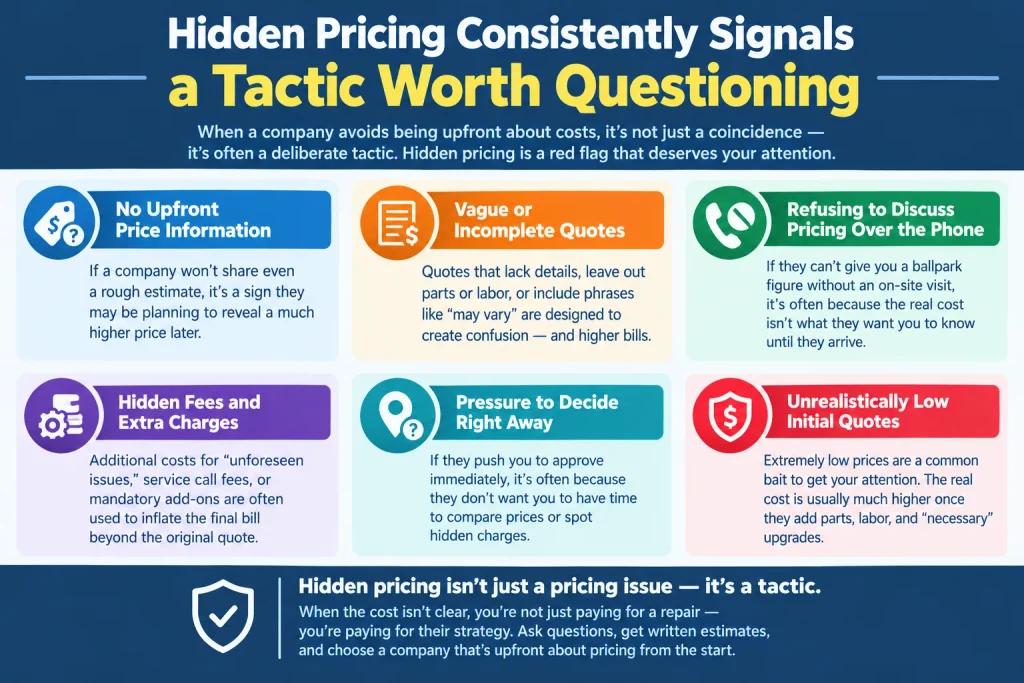
Dishonest operators depend on withheld pricing to protect nearly every other tactic covered above, since transparency undoes each one at once. Insisting on clear numbers before approving anything closes off most of these patterns from the very first conversation, long before any real money changes hands.
Guardian Door & Gate provides upfront, written pricing for homeowners throughout St. Louis, MO, regardless of how routine or urgent the repair seems or what time of day the call comes in. Contact us or give us a call today, and let our trained technicians explain every cost clearly from the first phone call through the final invoice.
Frequently Asked Questions
Why do some technicians refuse to give any price over the phone?
Refusing to give any price over the phone sometimes reflects genuine uncertainty a garage door technician has before seeing the door in person, especially for a same-day repair service. A refusal paired with pressure to schedule immediately deserves closer scrutiny.
Can a homeowner stop a technician from disassembling the door?
Declining to allow disassembly before receiving a written estimate is entirely reasonable and protects against a garage door company charging for unnecessary parts. A technician resistant to this request deserves immediate caution.
How can a homeowner verify a part charge is legitimate?
Requesting to see the specific part, along with its brand and model number, usually confirms whether the quality work reflects a real component still in good condition. A company unwilling to show the part deserves added scrutiny.
Does a fake business listing always use a completely made-up name?
A fake listing sometimes uses a name closely resembling a legitimate company rather than something entirely invented, often paired with fake websites built to look convincing. Checking the listed physical business address and phone number against public records usually reveals the discrepancy.
Is it reasonable to request a written quote before agreeing to a repair?
Requesting a written quote before agreeing to any repair is a completely reasonable expectation from any reputable garage door repair company in the area. A company unwilling to provide one deserves closer scrutiny before you approve the work.
What should a homeowner do if a technician discourages a second opinion?
Requesting a second opinion anyway, even from another professional garage door company, protects you from a recommendation built on pressure rather than genuine need. A technician who reacts defensively deserves added caution, and the extra step often brings real peace of mind.
Does hidden pricing always indicate the company plans to disappear afterward?
Hidden pricing does not always indicate an intent to disappear, though it removes the accountability that protects against exactly the kind of unidentified technician scam an independent contractor might attempt. The pattern still deserves the same level of caution either way.
How quickly should a homeowner expect a written estimate after a phone call?
A legitimate company should provide a written estimate reflecting fair service costs before any work begins, regardless of how the initial phone call unfolds, and the number should track close to the average cost for similar jobs. Treat extended delays or repeated excuses as a warning sign.
Can a homeowner report a company using fake local listings?
Reporting a company using fake listings to the Better Business Bureau or a consumer protection agency helps document the pattern through detailed customer feedback for other homeowners. This documentation also supports any dispute over charges already paid.