Choosing the right security gate for a commercial property means evaluating the site layout, daily traffic volume, and the exact level of security the business actually needs. Confirming those factors early on prevents wasted budget on a gate system that never truly fits the property in the first place.
Planning ahead for gate installation also means deciding on gate type, material, and access systems before a contractor ever arrives on site. This guide walks through each of those decisions in order, along with the safety features and access control options that shape a lasting choice for any commercial property.
Key Takeaways
- Traffic volume and available space narrow down the best gate type fast
- Safety features protect vehicles, pedestrians, and property from unauthorized entry
- Access control systems shape daily traffic flow for staff and visitors
- Material choice affects both durability and long-term security measures
- The installation process varies based on gate type and site conditions
Factors to Consider Before Choosing a Commercial Security Gate
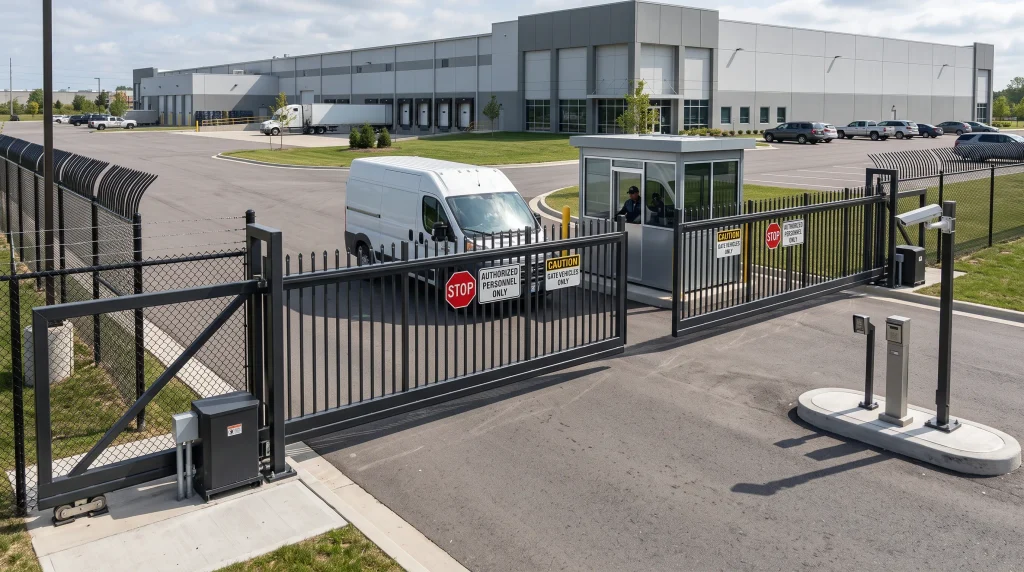
A commercial gate has to match the property it protects, since the wrong type creates daily friction instead of a smooth operation.
The most important factors to weigh before deciding include:
- Traffic volume during peak business hours and shift changes
- Available space along the entry point and surrounding property line
- Security requirements based on the type of property and its contents
- Vehicle access needs, including delivery trucks and larger equipment
- Budget and timeline for installation and ongoing maintenance
Weighing these factors early prevents a costly mismatch between the access control setup a property needs and the gate eventually installed.
Types of Commercial Security Gates
Commercial properties rely on several different types of commercial gates, each suited to a different combination of space, traffic, and security needs.
| Gate Type | Best Suited For | Space Requirement | Typical Traffic Volume |
| Sliding gate | Wide openings with limited swing room, moves along a track parallel to the fence | Low, runs parallel to fence line | Moderate to high |
| Swing gates | Properties with plenty of clearance, opens inward or outward in single or double panels | High, needs open swing radius | Low to moderate |
| Cantilever gate | Sites with snow, dirt, or heavy daily use, since it runs on rollers without a ground track | Low, no ground track needed | Moderate to high |
| Vertical lift gates | Ultra tight layouts needing maximum security with zero side clearance | Low horizontal, needs overhead clearance | High |
| Pivot gates | Heavier gates needing smooth rotation on a single side | Moderate, needs pivot point clearance | Low to moderate |
| Bi-folding gates | Tight spaces requiring very fast open and close cycles | Low, panels fold inward | High |
| Barrier arms | High speed vehicle access, parking lots, and toll lanes | Minimal, arm only | High |
| Pedestrian turnstiles | Controlled foot traffic at lobbies and building entrances | Minimal, rotating unit only | High foot traffic |
To find the type that best suits a specific site layout, daily traffic pattern, and long-term security needs, read our guide on Types of Security Gates Used for Commercial Property, which breaks down every option in far greater detail.
How to Choose the Right Commercial Security Gate
Step 1: Assess Site and Security Needs
Evaluating a site closely before selecting any gate reveals exactly where a property currently stays vulnerable and why.
Getting this stage right usually means covering the following:
- Spotting weak points and blind spots near loading docks or side entries
- Measuring entry width against the largest vehicle expected on site
- Confirming local zoning and fire department access rules apply
- Reviewing how current perimeter security handles peak hour traffic
- Flagging past unauthorized access to target those exact weak points
Turning a general security goal into a specific, workable plan for the entire property starts with getting this assessment right first.
Step 2: Choose the Right Gate Type
Finding the correct gate type for a property comes down to space, traffic, and how the entry gets used daily.
Narrowing down the right option takes a few practical steps:
- Walk the property line to confirm how much side or swing space actually exists
- Track peak hour traffic patterns to see how often the gate will cycle daily
- Match the gate to the heaviest vehicle type expected to pass through
- Weigh security priorities against how fast the gate needs to open and close
- Compare long-term maintenance needs across the gate types under consideration
Every other decision made throughout this entire process builds directly on whichever gate type gets chosen at this stage.
Step 3: Select Material and Durability
Durability starts with the material chosen, since the wrong choice wears down fast under daily weather and impact.
Commercial properties typically choose between:
- Steel for maximum strength near loading areas and heavy impact zones
- Aluminum for rust resistance in coastal or humid climates
- Chain link for a budget-friendly perimeter around large lots
- Wrought iron style frames where curb appeal matters near office entrances
- Reinforced panels for routes near industrial facilities with heavy traffic
The material chosen here directly determines how well a gate holds up against years of weather, impact, and constant daily use.
Step 4: Pick Drive and Access Systems
Smooth daily operation depends entirely on pairing the right drive motor with the right access method from the start.
The right combination generally includes:
- A heavy-duty motor rated for actual daily traffic, not just averages
- Keypads, card readers, or clickers matched to staff entry volume
- Safety loops and photo eyes that stop the gate on detected objects
- Gate automation systems synced directly with existing access control setups
- Remote access for managing entry without staff on site
Fast and secure daily operations for years to come across the entire property depend on getting this pairing right from day one.
Step 5: Coordinate Installation and Ongoing Maintenance
Long-term performance depends heavily on planning installation and maintenance together, not treating either as an afterthought.
A solid plan generally accounts for:
- Hiring a licensed commercial gate installer with proven project experience
- Scheduling yearly checkups for track lubrication and sensor testing
- Confirming warranty terms cover both parts and labor upfront
- Building a maintenance schedule around actual traffic volume
- Logging install details and part numbers for faster future service
Protecting the investment for the long haul comes down to a maintenance routine built to prevent unnecessary gate repair work.
Safety Features to Look for in a Commercial Gate System
Safety features protect vehicles, pedestrians, and security personnel from the exact risks a moving gate creates every day.
The most important features to confirm before installation include:
- Photo eye sensors that stop the gate when something blocks its path
- Safety edges along the leading edge that detect contact instantly
- A manual release option for use during a power outage
- Compliance with current UL 325 safety standards for automated gate systems
- Clear warning signage posted at all vehicle and pedestrian entry points
To understand exactly which features separate a safe commercial gate from a liability, read our guide on What Safety Features Should a Commercial Security Gate Have?, which covers each requirement in complete detail.
Access Control Options for Commercial Properties
Access control decides who gets through a gate, when, and under what conditions, which makes it one of the most important decisions in the entire setup.
Commercial properties typically choose from:
- Keypad entry for straightforward, low-cost staff access
- Card or badge readers for larger office complexes with many employees
- Intercom systems that let staff verify visitors before granting entry
- Remote access apps that manage entry from a phone or tablet
- Video surveillance integration that logs every entry alongside access data
A well-planned access control setup gives a commercial property genuine peace of mind against unauthorized entry and constant security gaps.
What to Expect During the Installation Process
The installation process for a commercial security gate follows a fairly predictable sequence from first site visit to final testing.
Most installations move through these stages:
- An initial site visit to confirm measurements and existing conditions
- Permitting and approval, which varies based on local zoning rules
- Site preparation, including grading and any needed electrical work
- Gate and operator installation, followed by full system calibration
- Final testing of safety sensors, access points, and automation systems
To get a clear sense of how long each of these stages typically takes for a property like this one, read our guide on How Long Does It Take to Install a Commercial Security Gate?, which lays out realistic timelines from start to finish.
Finding the Right Gate for Long-Term Security
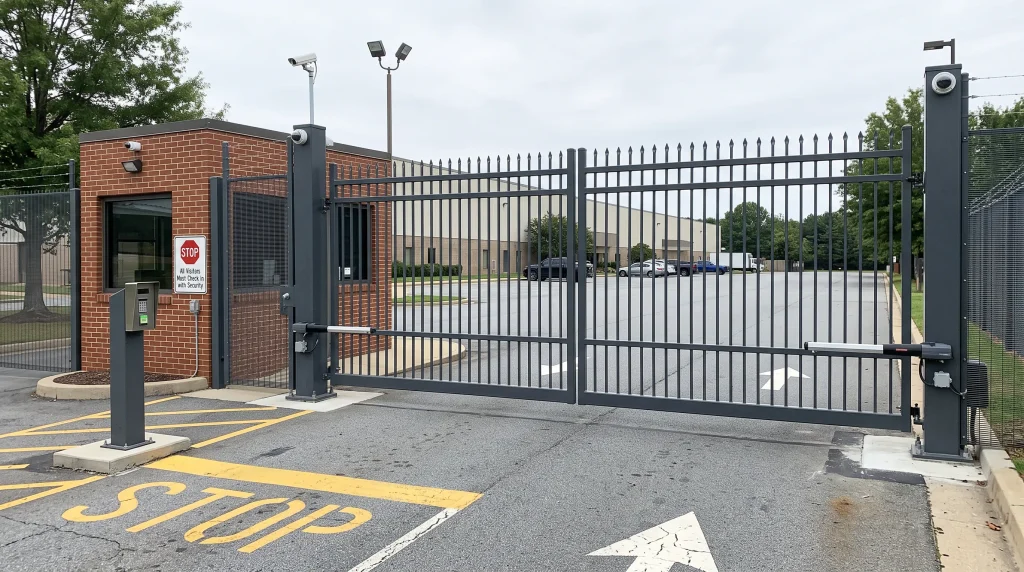
A commercial property rarely gets protected well by guesswork, since the right gate depends entirely on traffic patterns, available space, and the exact level of security the business needs day to day. Getting these decisions right from the start avoids a mismatch that causes problems for years afterward.
Guardian Door and Gate has helped commercial properties across St. Louis, MO match the correct gate type, material, and access system to the exact demands of their site. Contact us or give us a call today, and let our team help select a gate built around the property’s actual traffic and security needs.
Frequently Asked Questions
How does traffic volume affect which commercial gate gets chosen?
Higher traffic volume usually points toward vertical lift gates or barrier arms, since both cycle faster than standard swing gates. Lower traffic properties have more flexibility to choose from a wider range of gate options based on appearance or budget instead.
Do commercial security gates need to meet specific safety standards?
Commercial security gates need to meet current security requirements covering sensors, manual release options, and clear signage at every entry point. A licensed gate installer will know exactly which security measures apply based on the type of property and gate type involved.
Can an existing gate be upgraded with better access control?
Existing gate systems can typically be upgraded with new access control systems without replacing the entire commercial gate structure. This makes it a practical option for properties that already have a working gate but need advanced access control for entry management.
What is the difference between a swing gate and a sliding gate?
Swing gates open outward or inward on a hinge, which needs open space in front of the entry point. A sliding gate moves parallel to the fence line instead, making it the better fit where available space near the entrance is limited.
How much does professional installation typically add to the total cost?
Professional installation costs vary based on gate type, site conditions, and any automation systems or electrical work required. A licensed gate installer can typically provide an accurate estimate after a full review of the property's security needs.
What maintenance does a commercial gate need after installation?
A commercial gate needs routine lubrication, sensor testing, and hardware checks scheduled at least once a year. Properties with higher traffic volume often benefit from more frequent checkups to protect perimeter security and catch wear early.
Can a commercial gate system integrate with existing surveillance systems?
Modern gate systems can typically integrate with existing surveillance systems, allowing video surveillance integration and entry logs to sync automatically. This combination gives security personnel a clearer record of every vehicle and pedestrian that passes through entry points.
Are barrier arms a good fit for office complexes with visitor parking?
Barrier arms work well for office complexes managing high vehicle access during visitor parking, since they cycle quickly without needing a wide swing area. Pairing a barrier arm with intercom systems or a badge reader adds an extra layer of security control for staff versus visitor traffic flow.
How long does a typical commercial gate installation take from start to finish?
A typical installation process takes anywhere from a few days to a couple of weeks, depending on site preparation and permitting. Larger or more complex automation systems tend to add extra time to the final testing phase for smooth operation.