Commercial properties rely on eight main types of security gates, each built to handle a different combination of space, traffic, and security needs. Sliding gates, swing gates, cantilever gates, vertical lift gates, pivot gates, bi-folding gates, barrier arms, and pedestrian turnstiles each solve a distinct set of site challenges.
Understanding what separates one gate type from another makes the difference between a smart choice and a costly mismatch once gate installation begins. This guide breaks down every option in detail, along with the traits that make each type the better fit for a specific commercial property.
Key Takeaways
- Available space and daily traffic volume narrow down the best gate type fast
- Sliding gates and swing gates remain the most common commercial options
- Vertical lift gates and pivot gates solve tight clearance problems well
- Barrier arms and pedestrian gates separate vehicle and foot traffic cleanly
- The right commercial gate depends on site layout more than appearance alone
Comparing the Main Types of Commercial Security Gates
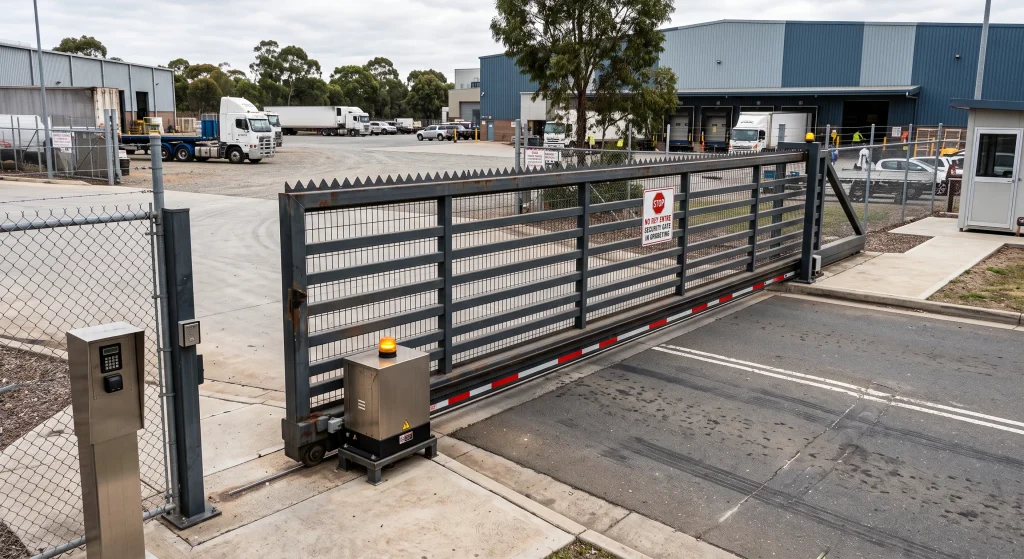
Eight distinct gate types cover nearly every commercial property layout, and comparing them side by side makes the practical differences clear.
| Gate Type | Ideal Property Type | Automation Compatibility | Maintenance Level |
| Sliding gate | Wide entries with side clearance | Pairs easily with standard motor drives | Moderate, depends on track cleanliness |
| Swing gates | Properties with deep front clearance | Works with most hinge-mounted operators | Moderate, hinge wear needs checks |
| Cantilever gate | Sites with snow, dirt, or heavy use | Handles high cycle automation well | Low, no ground track to clog |
| Vertical lift gates | Tight layouts needing high security | Requires a dedicated lift mechanism | Moderate, overhead parts need inspection |
| Pivot gates | Heavier gates on a single side | Works with standard pivot operators | Moderate, pivot point needs lubrication |
| Bi-folding gates | Tight spaces needing fast cycles | Built for rapid automated cycling | Low, fewer heavy components to wear |
| Barrier arms | High volume parking and toll lanes | Integrates easily with ticketing systems | Low, simple arm mechanism |
| Pedestrian turnstiles | Controlled foot traffic at entries | Pairs well with access control systems | Low, minimal moving parts |
Sliding Gates
A sliding gate moves along a track parallel to the fence line, making it one of the most common choices for commercial properties with limited space in front of the entry.
A few traits explain why this type of gate fits so many sites:
- Side clearance running the full length of the gate replaces the need for swing room
- Heavier commercial panels stay supported without sagging under their own weight
- Frequent vehicle access benefits from a fast, consistent open and close cycle
- A straight, level track area keeps the gate system running smoothly for years
- Automation systems pair easily with a sliding gate’s simple linear motion
To understand exactly how site layout and traffic volume shape this decision, read our guide on How to Choose the Right Security Gate for Commercial Property, which walks through every factor in order.
Swing Gates
Swing gates open inward or outward on a hinge, in single or double panel configurations, suited to properties with room to spare in front of the entry.
Several property traits point toward this gate type:
- Deep front clearance with no obstructions along the swing path
- A property image where curb appeal matters as much as daily function
- Lower traffic volume that does not demand a rapid cycle time
- Solid structural support at the hinge point for a heavy commercial gate
- Fewer moving parts than a sliding gate, which can reduce gate repair needs over time
A swing gate suits commercial properties willing to trade rapid cycling for a more classic, open entrance style overall.
Cantilever Gates
A cantilever gate is a sliding gate suspended on rollers instead of running along a ground track, keeping it clear of snow, dirt, and heavy daily traffic.
This type of gate works especially well where:
- Ground conditions make a traditional track impractical or hard to maintain
- Snow, gravel, or debris regularly collect near the entry point
- High traffic volume puts repeated stress on moving parts
- A cleaner sightline matters more than a low-profile ground track
- Advanced access control systems integrate easily with the cantilever’s open design
Properties dealing with rough ground conditions often find a cantilever gate solves problems a standard track never could.
Vertical Lift Gates
Vertical lift gates rise straight up instead of sliding or swinging, making them a strong fit for properties with strict spatial limits on both sides of the entry.
A handful of factors make this gate type stand out:
- Limited horizontal space on either side of the entry point
- High traffic volume that benefits from a fast vertical lift cycle
- Overhead clearance available to house the lift mechanism itself
- Maximum security in layouts where zero side clearance exists
- Gate automation built specifically for repeated, high frequency cycling
The added overhead clearance this gate type requires is often the only real tradeoff worth weighing for the tight footprint it ultimately delivers.
Pivot Gates
A pivot gate rotates upward on a single side rather than lifting straight up, suiting heavier commercial gates that need smooth rotation without a full lift system.
Properties that benefit most from a pivot gate share a few traits:
- A single strong pivot point instead of a full track or lift mechanism
- Heavier gate materials that a standard hinge could not support long-term
- Moderate traffic volume that does not require constant rapid cycling
- Simpler mechanical design that keeps long-term upkeep relatively low
- Compliance with current gate safety standards built into the operator system
Properties choosing between a pivot gate and a full vertical lift system often find the pivot design costs less to install overall.
Bi-Folding Gates
Bi-folding gates fold their panels in on themselves, allowing very fast opening and closing speeds in spaces too tight for a standard swing gate.
This type of gate tends to fit properties with:
- Limited space that rules out a wide swinging arc entirely
- High traffic volume that benefits from a rapid fold-and-open motion
- Multiple access points where speed matters more than gate size
- Lighter panel weight compared to a full sliding or lift gate
- A modern property image where a custom gate design adds curb appeal
Speed and a compact footprint make bi-folding gates a strong fit for busy, space-constrained entrances.
Barrier Arms
Barrier arms use a simple lifting arm rather than a full gate panel, which makes them the standard choice for high-volume parking lots and toll-style entries.
A few specific traits make barrier arms the right system for certain sites:
- High vehicle access volume where speed matters more than a physical barrier
- Lower security requirements compared to a full perimeter security gate
- Minimal space needed, since only the arm itself needs clearance
- Simple integration with keypads, ticketing systems, or remote access
- Common use across office complexes managing daily visitor parking
To confirm which safety features a barrier arm still needs despite its minimal physical footprint, read our guide on What Safety Features Should a Commercial Security Gate Have?, which covers each requirement in complete detail.
Pedestrian Turnstiles
Pedestrian turnstiles are rotating gates built specifically to control foot traffic, separate from whatever vehicle gate system handles cars and trucks at the same property.
Properties that benefit from adding a turnstile typically have:
- High foot traffic volume concentrated at specific entry points
- A need to separate pedestrian gates from vehicle lanes for safety
- Security personnel stationed nearby to monitor entry patterns
- Existing surveillance systems that pair well with controlled foot access
- Industrial facilities or office complexes with strict entry logging needs
To gauge how much extra time a turnstile adds to a property’s total installation schedule, read our guide on How Long Does It Take to Install a Commercial Security Gate?, which lays out realistic timelines from start to finish.
Choosing a Gate Type That Fits the Property
Comparing a handful of practical factors side by side makes the final decision far easier than weighing all eight types at once.
The most useful comparisons include:
- Cross-checking gate width against the entry point’s actual clearance
- Ranking security priorities against how quickly the gate needs to cycle
- Comparing automation compatibility across the shortlisted gate options
- Estimating long-term upkeep for each candidate under daily use
- Getting a second opinion from a licensed gate installer on site
The right gate type ultimately comes down to which option holds up best under the property’s real daily conditions.
The Right Commercial Gate Type Comes Down to the Property Itself
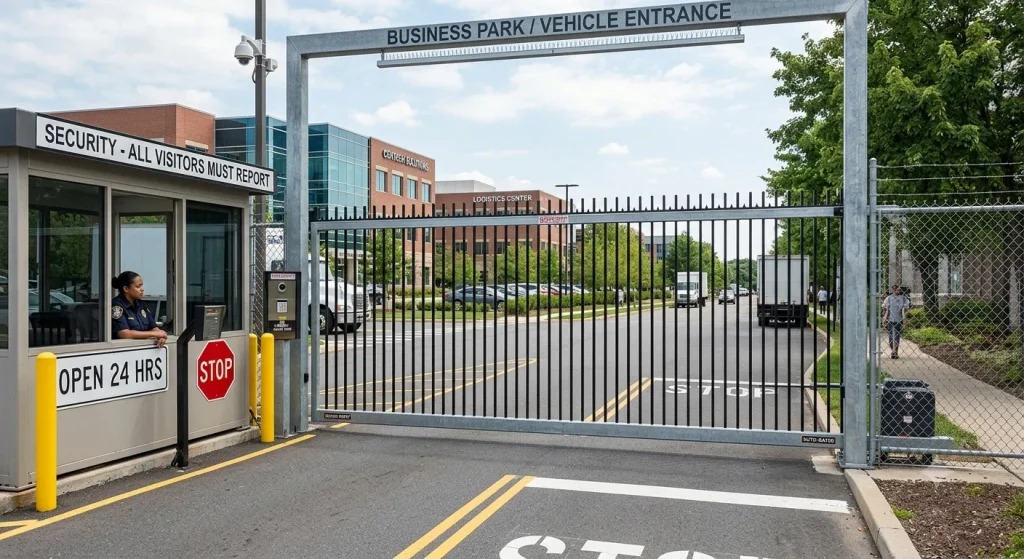
Commercial properties each carry their own combination of space, traffic, and security needs, and the right gate type comes from weighing those specifics carefully against the site. Comparing all eight options against those factors narrows the decision down to what actually fits the property long term.
Guardian Door and Gate matches every gate type to the exact site layout and daily traffic pattern of properties across St. Louis, MO, so the decision holds up long after installation. Contact us or give us a call today, and let our team walk through which gate options genuinely best suit the property’s specific needs.
Frequently Asked Questions
How is a cantilever gate different from a standard sliding gate?
A cantilever gate runs on rollers above the ground instead of following a ground-level track, which keeps it clear of snow, dirt, and debris. A standard sliding gate relies on that ground track, which can require more frequent cleaning in rough conditions.
Which gate type works best for high-traffic commercial entrances?
Vertical lift gates and barrier arms both handle high traffic volume well, since each cycles faster than a standard swing gate. The right pick between the two depends on whether vehicle access or pedestrian separation matters more.
Are pivot gates a good option for narrow commercial driveways?
Pivot gates work well for narrow driveways carrying heavier gate materials, since the single pivot point needs less clearance than a full swing arc. Moderate traffic properties benefit most from this type of gate.
What makes bi-folding gates a good fit for tight spaces?
Bi-folding gates fold their panels inward, which lets them open and close quickly without needing the wide arc a swing gate requires. This makes them a strong option for properties with several entry points close together.
Do barrier arms provide the same security level as a full gate?
Barrier arms provide a lower level of security than a full gate panel, since they control vehicle access without creating a solid physical barrier. Properties with lower security requirements or high visitor volume still find them a practical, cost-efficient system.
Can pedestrian turnstiles be added alongside a vehicle gate?
Pedestrian turnstiles can be added alongside almost any vehicle gate system to separate foot traffic from cars and trucks. This combination works especially well at office complexes and industrial facilities with steady foot traffic.
How does available space affect which gate type gets chosen?
Available space often rules out certain gate types immediately, since a sliding gate needs side clearance and a swing gate needs front clearance. Properties with limited horizontal space on both sides often turn to vertical lift or pivot gates instead.
Are vertical lift gates more expensive to install than sliding gates?
Vertical lift gates typically cost more to install than sliding gates, largely due to the overhead mechanism required for the lift cycle. The added cost often makes sense for properties with strict spatial limits and high security needs.
Which gate type requires the least maintenance over time?
Cantilever gates and bi-folding gates tend to need the least maintenance over time, since both avoid components that wear down quickly under heavy use. Regular inspections still matter for every gate type regardless of how low maintenance it is by design.